
Russian TV Rewind
I went to fact-check a meme about a priest and Disney cartoons, and found a way to study recent Russian history through a TV schedule.
Open the project ↗It started with this meme:
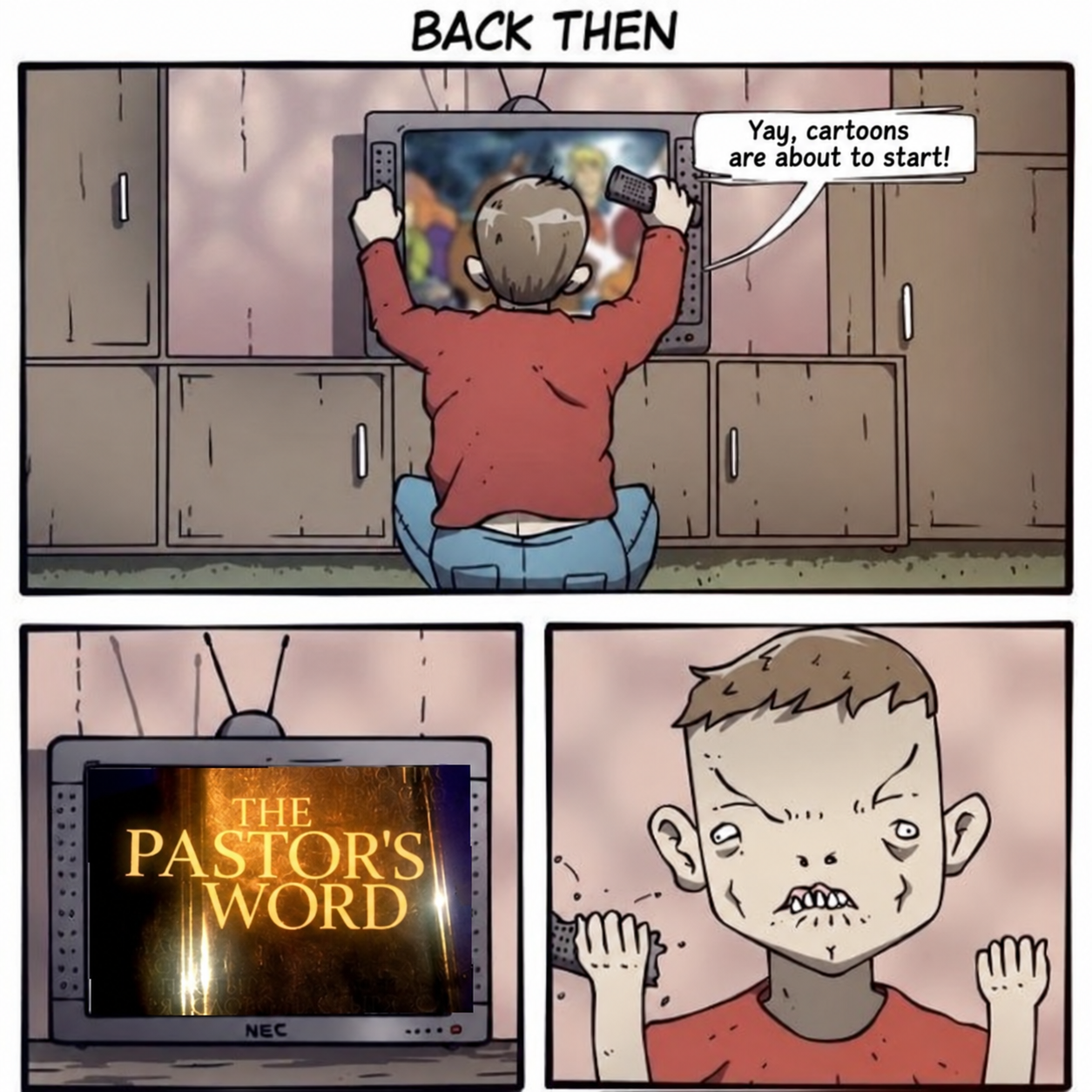
For a generation of Russian kids, weekend cartoons came with a catch: sometimes an Orthodox priest was still on screen when Disney was supposed to start. I wanted to check whether this actually happened, or whether it was a Mandela effect.
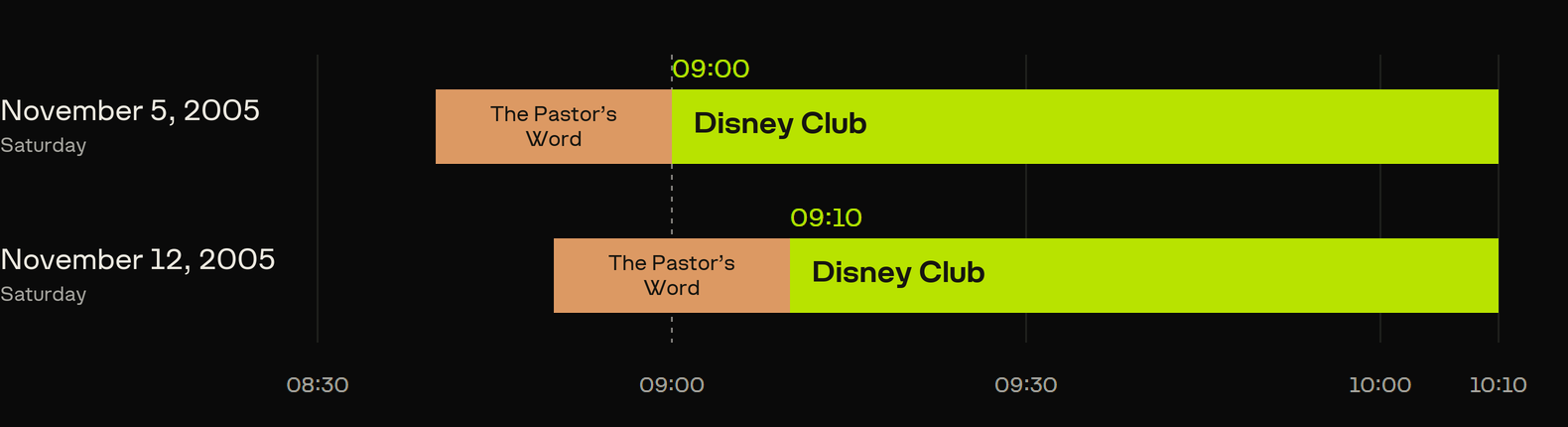
I started with the schedule archive of Channel One, one of Russia’s main national TV channels. I compared two consecutive Saturdays by hand: November 5 and 12, 2005.
Sure enough, on the first Saturday, the sermon, The Pastor’s Word, ends at 9:00 a.m., followed by Disney Club. A week later, the sermon is scheduled ten minutes later, and Disney starts at 9:10. Switch on at the usual time, and the priest is still there. People remembered it correctly.
Yes, he did. Now I wanted to know how often. I used the same archive to count.
Each listing is one scheduled airing. Repeats count separately.
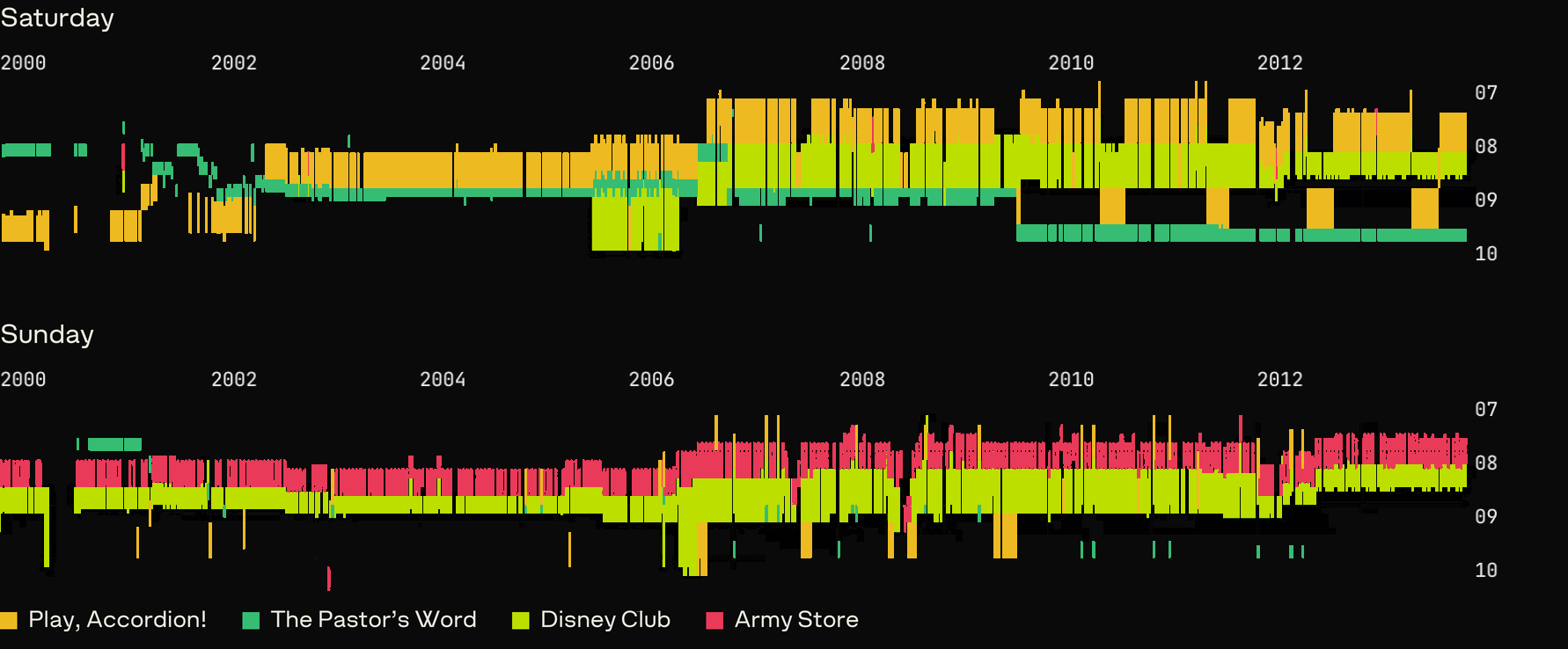
I selected every Saturday and Sunday with Disney Club. For each date, I estimated the usual cartoon start time on that day of the week using the eight weeks before and after it. When an episode started late, I checked what had occupied its usual slot.
The priest did occasionally get in Disney’s way: roughly one Saturday in 26. Army Store, a magazine show about military life, did much the same on Sundays: roughly one Sunday in 25.
After Disney, I kept scrolling. The archive had more than ten thousand days: nearly thirty years of TV schedules! Together, they showed how television and the country had changed.
That gave me an idea: could I look at recent Russian history through television? A schedule contains a bit of everything: audience tastes, money, politics, advertising, and someone’s idea of what people ought to watch.
I wanted to see the whole schedule in one picture and compare years: how much time went to movies, what ran in the mornings, and what filled the afternoons.
To compare airtime for movies, series, news, and concerts, I first had to classify the programs. Some descriptions already said “cartoon” or “concert”; regular expressions caught those. I sent the remaining titles and descriptions to Claude Sonnet 4.6, a large language model (LLM), and asked it to choose a category from a list.
Each program becomes a strip in its place on the schedule. Color shows its category; length shows the time until the next program starts. That calculation turned out to have a catch.
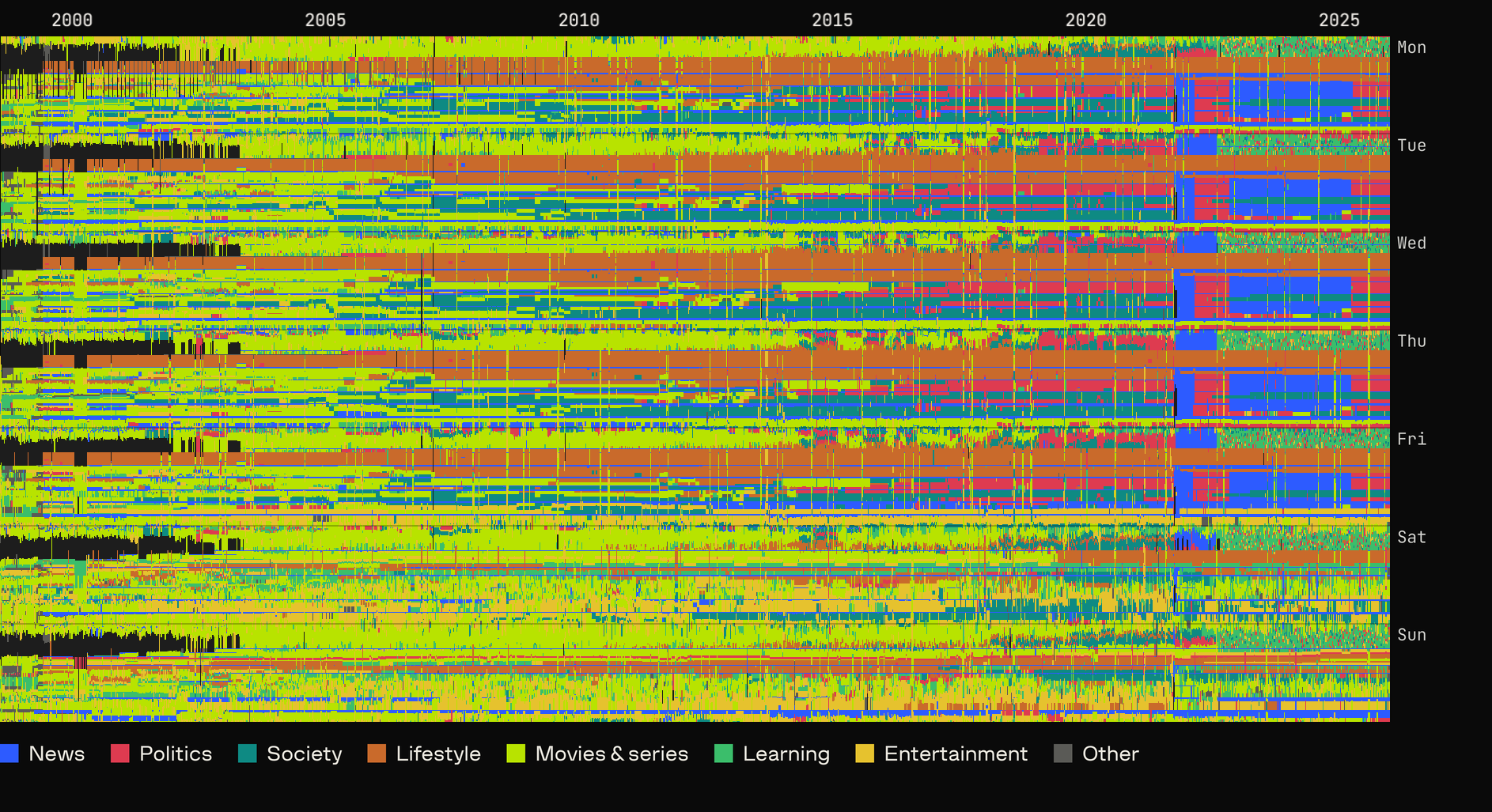
You can zoom from the full archive into a single week and read individual listings.
I imagined the switch from schedule to statistics as pouring colored sand. Programs leave their slots and settle into columns: you can watch the totals form. That animation was the reason I wrote my own renderer. I’m especially pleased with the pouring.
Next, I wanted to look at the movies themselves: where they came from, when they were made, their genres, and their IMDb ratings. That meant finding every title in IMDb or another film database and making sure I had the right movie.
Then I found two films with the same Russian title as Die Hard.
On May 8, 2001, Channel One aired Krepkiy Oreshek, starring Soviet actors Nadezhda Rumyantseva and Vitaly Solomin. On September 29, it aired that title again, this time with Bruce Willis. The first was a Soviet comedy from 1967. The second was Die Hard (1988), released in Russia under the same name: literally, “a tough nut.” The schedule title alone couldn’t tell them apart.

Mix them up, and a Soviet comedy adds hours to American action movies on the chart. So I checked the cast, release year, and synopsis against the original listing. Rumyantseva and Solomin were more useful clues than the title.
The Irony of Fate, a Soviet romantic comedy, had the opposite problem: one film hiding under dozens of entries. Full titles, shortened titles, “Comedy” added at the front, episode numbers at the end. Once, a Cyrillic “С” in its subtitle had even been replaced with an identical-looking Latin “C” (╯°□°)╯︵ ┻━┻.
All of those had to resolve to one film, while keeping its sequel and making-of documentaries separate.
Another favorite was Gentlemen of Fortune, a Soviet comedy about crooks. My table had somehow turned it into a 1990 US–South African production, with this synopsis:
A beautiful woman must prove her courage to inherit $28 million and win the man she loves. Planes, motorcycles, cliff jumps, alligators, and shootouts.
The matching process had attached a completely different film’s record to Gentlemen of Fortune, complete with a synopsis translated from English.
Honestly, I’d watch it.

Runtimes were another treat. According to the archive, on March 19, 2000, Predator ran from 10 p.m. to 6 a.m. Eight hours of Schwarzenegger in the jungle. The overnight edition.
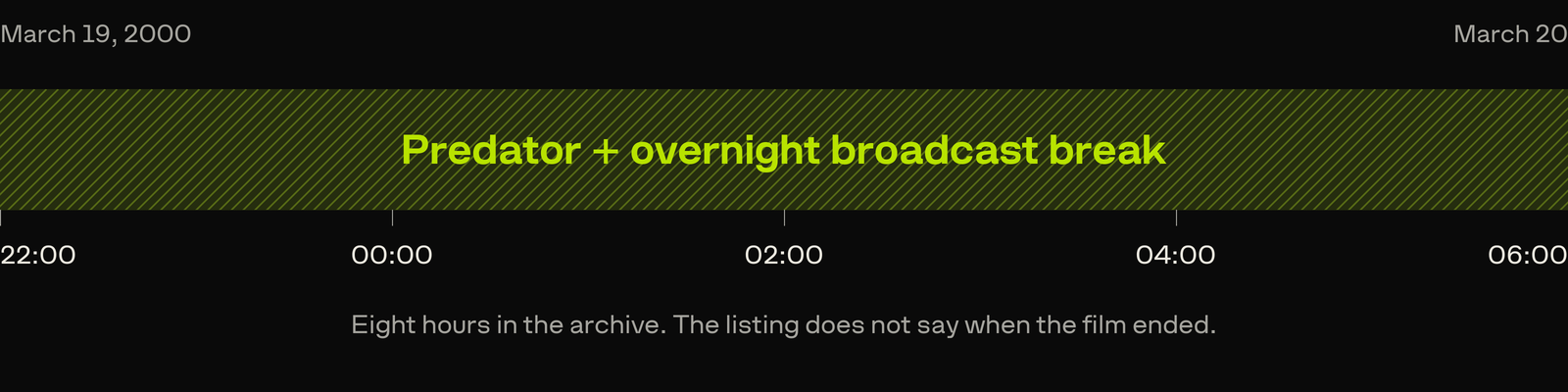
Those eight hours included the overnight broadcast break. Channel One only began broadcasting around the clock in October 2003. Calculate runtime from the next listing, and the whole break gets counted as American cinema.
I excluded these overnight gaps from the totals. The listing still can’t tell us when Predator actually ended.
I matched movies and series to records in IMDb, OMDb, TMDB, and Wikidata. These sources supplied production countries, release years, and genres. IMDb ratings came through the OMDb API.
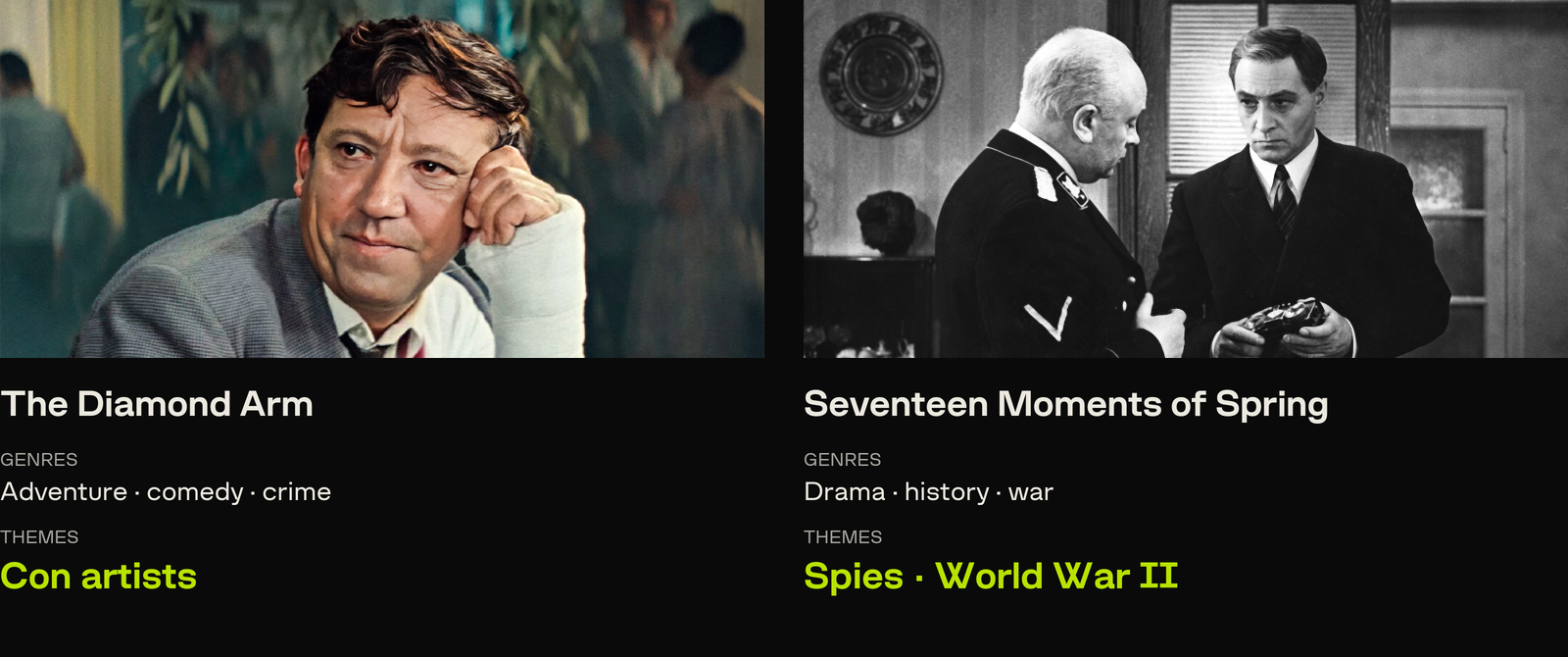
Matching films gave me countries, release years, and genres. But genres don’t say much about what a film is actually about. The Diamond Arm, a Soviet comedy about smugglers, is tagged as adventure, comedy, and crime. That same “crime” category also covers police stories, mafia films, and heists.
So I added a separate set of themes: what the story is about and who is in it.
I gave the model a synopsis and a list of themes to choose from. The Diamond Arm got “Con artists.” Seventeen Moments of Spring, a series about a Soviet spy in Nazi Germany, got “Spies” and “World War II.”
I made several passes: checked the results on films I knew, revised the themes and the model’s instructions, then ran the classification again.
Now the same movie schedule can be colored by IMDb rating, genre, or theme. The programs stay in place; we see a different aspect of them.
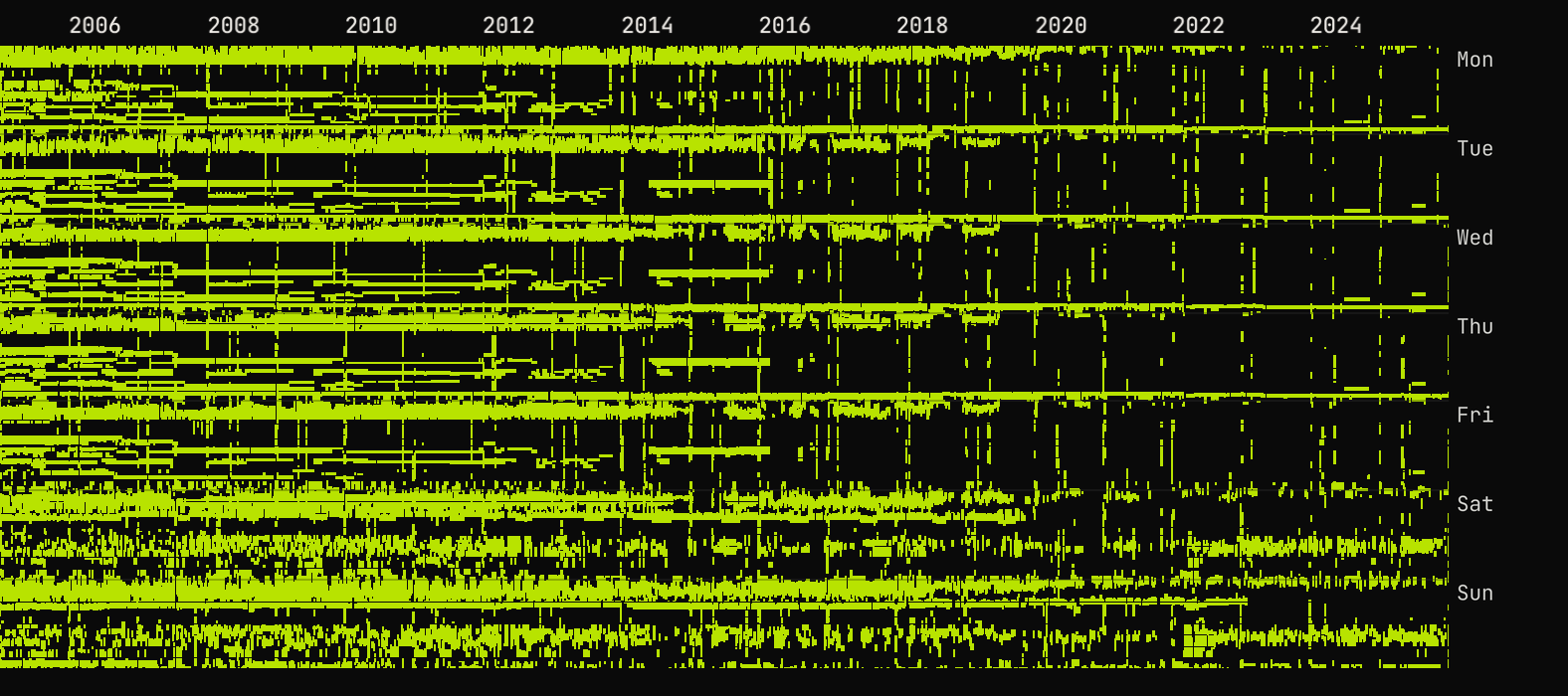
In 2005, movies and series occupied half of Channel One’s airtime. By 2025, they took up less than a tenth. Their annual airtime fell roughly fivefold over twenty years, from 4,342 to 844 hours.
Meanwhile, political and social talk shows grew. Together, they took up 3.5% of airtime in 2005 and 20.4% in 2025. Movies increasingly gave way to people talking about politics, social issues, and other people’s family disasters.
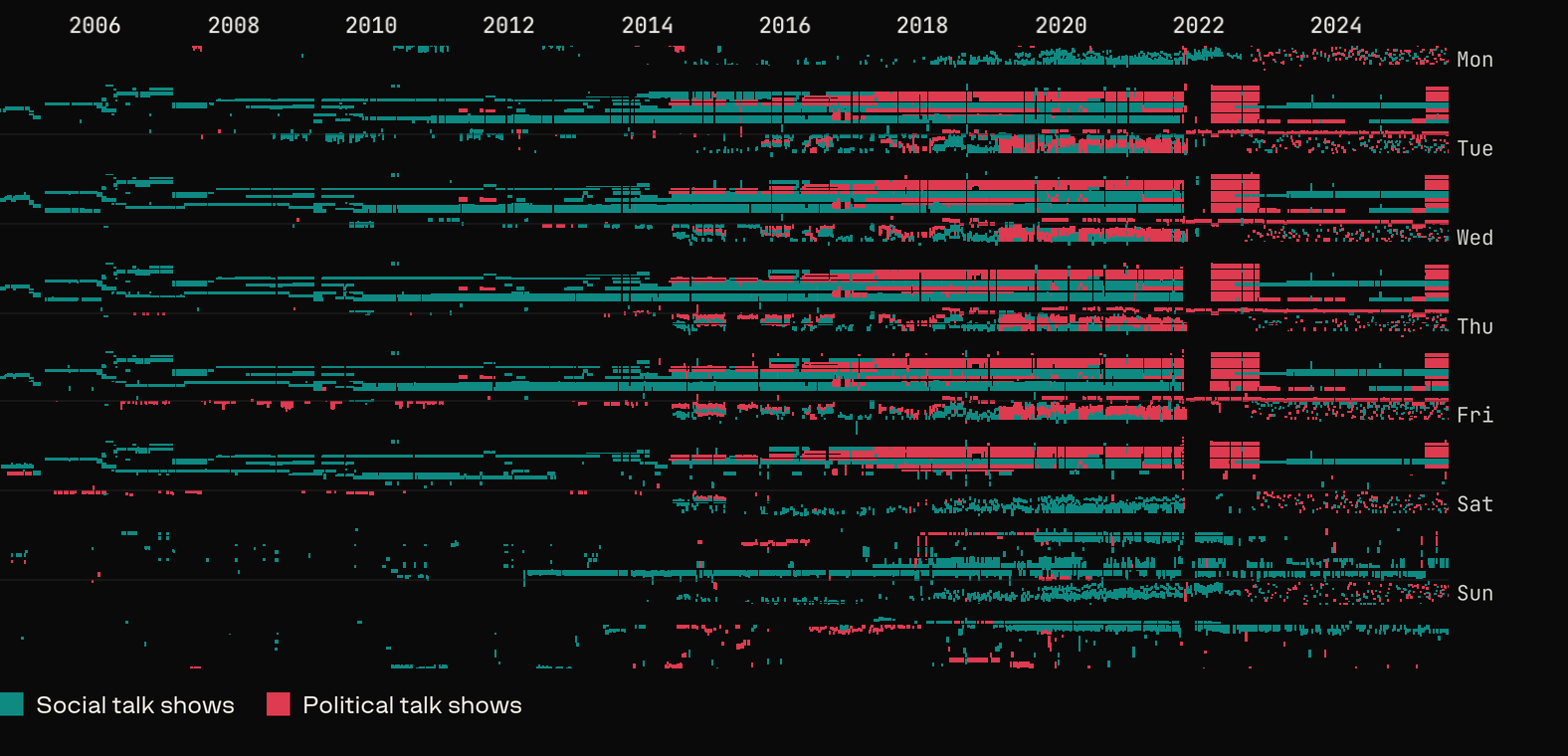
Political talk shows grew especially fast. In 2013, there were just 30 hours for the entire year, averaging five minutes a day. From January to early June 2026, they averaged almost five hours a day. Their share of airtime rose from 0.35% to 19.9%, roughly 57-fold.
The sharp rise begins in fall 2014. On September 15 at 3:15 p.m., the political talk show Time Will Tell appears in the schedule for the first time. Brazilian soaps and a courtroom show called Federal Judge had once occupied that slot. By 2015, political talk shows were taking up 486 hours a year.
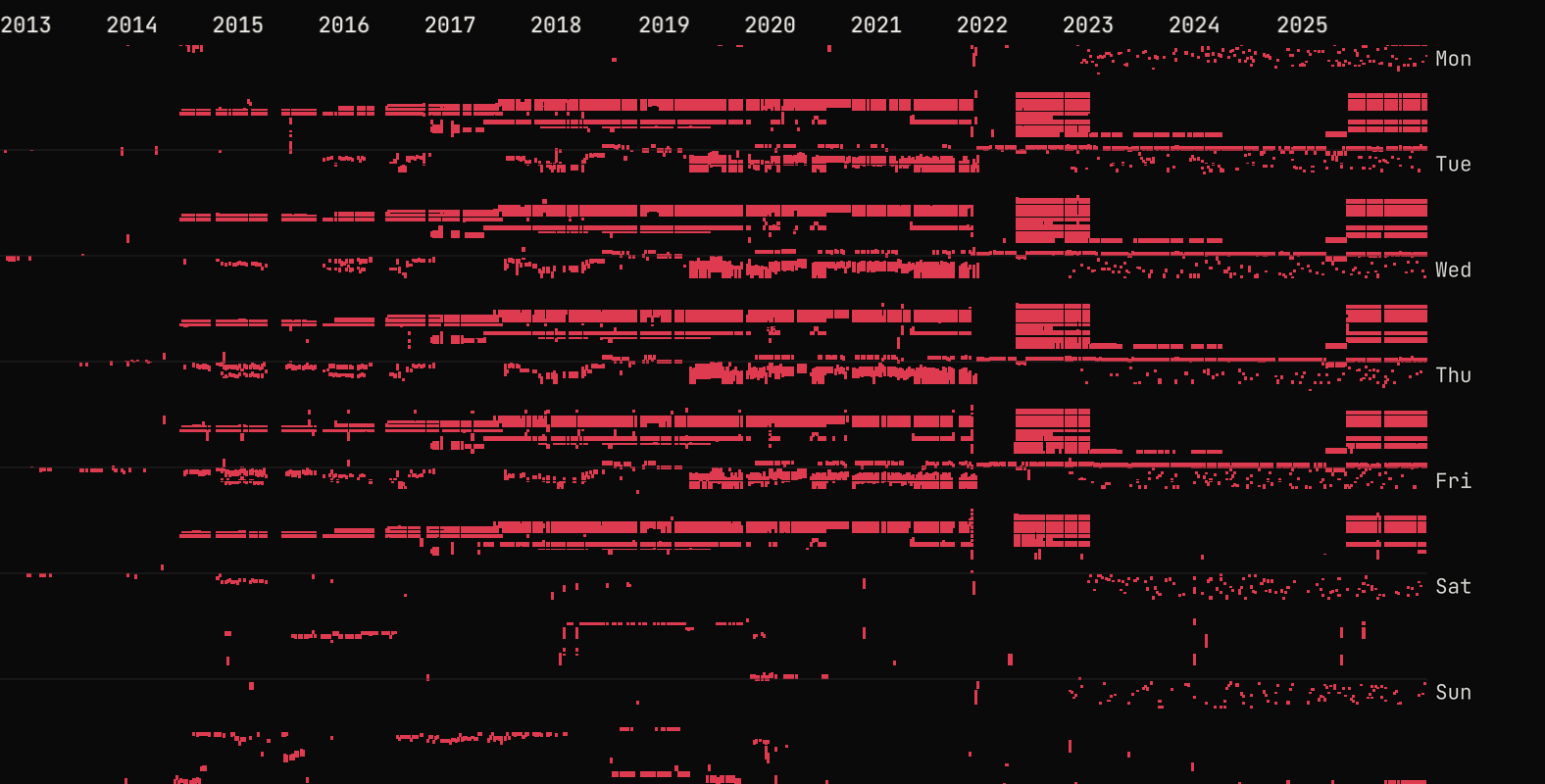
The archive contains 1,819 airings of foreign movies and series in 2005. In 2014, there were 816; in 2019, 195; in 2025, just 39. These counts include repeats; international co-productions are counted separately.
The decline began long before 2022. By 2019, the number of airings was already down to about 11% of its 2005 level. The few remaining titles in 2025 included Triangle of Sadness, Black Box, and several episodes of Sherlock & Daughter.
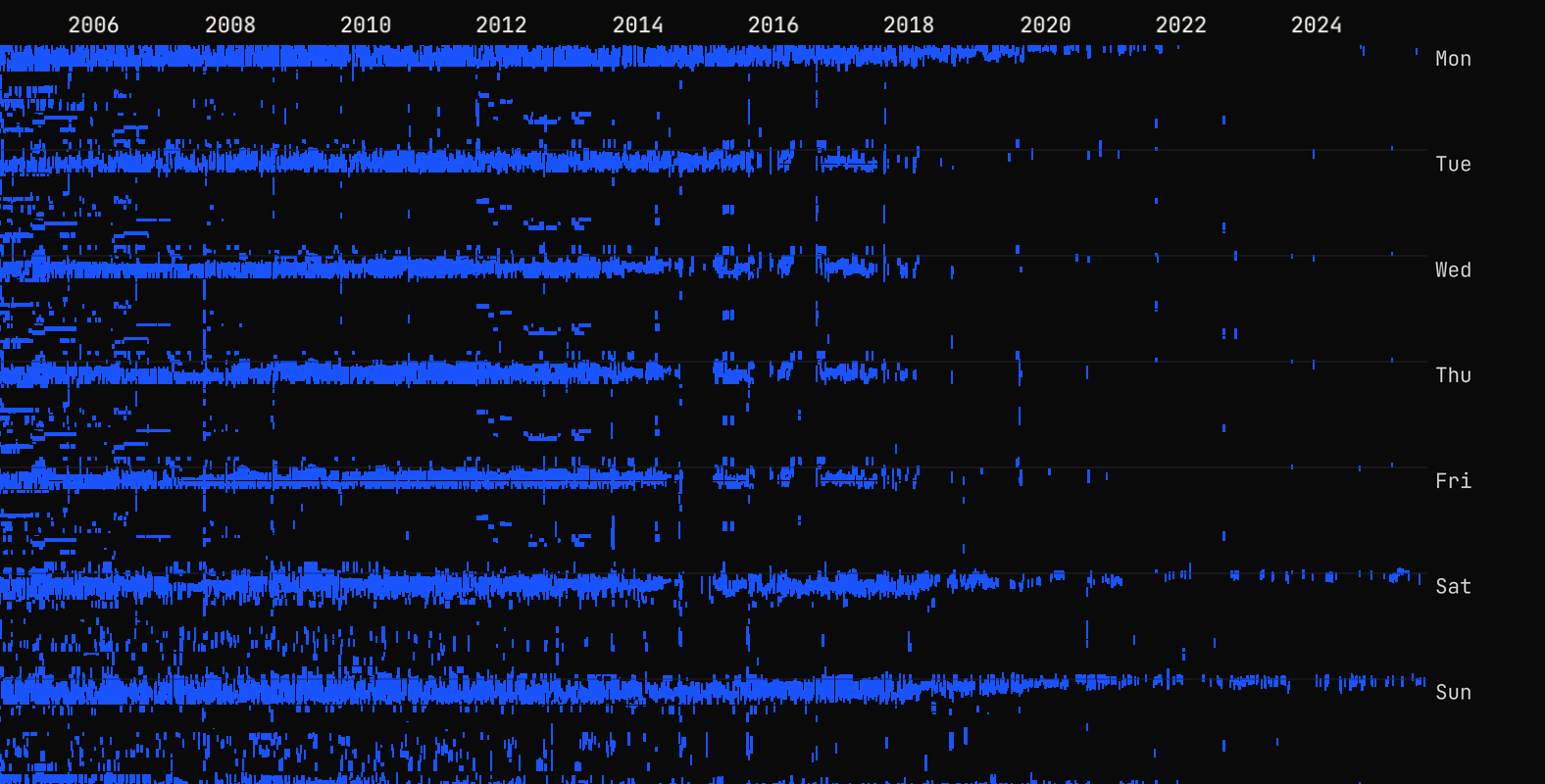
Domestic productions did gain share: Russian and Soviet movies and series accounted for 41% of movie-and-series airtime in 2005, rising to 90% in 2025. Nearly all the fiction on Channel One is now domestic.
But their actual airtime fell too: from 1,762 hours a year to 762. Foreign productions disappeared even faster, so the Russian and Soviet share kept growing.
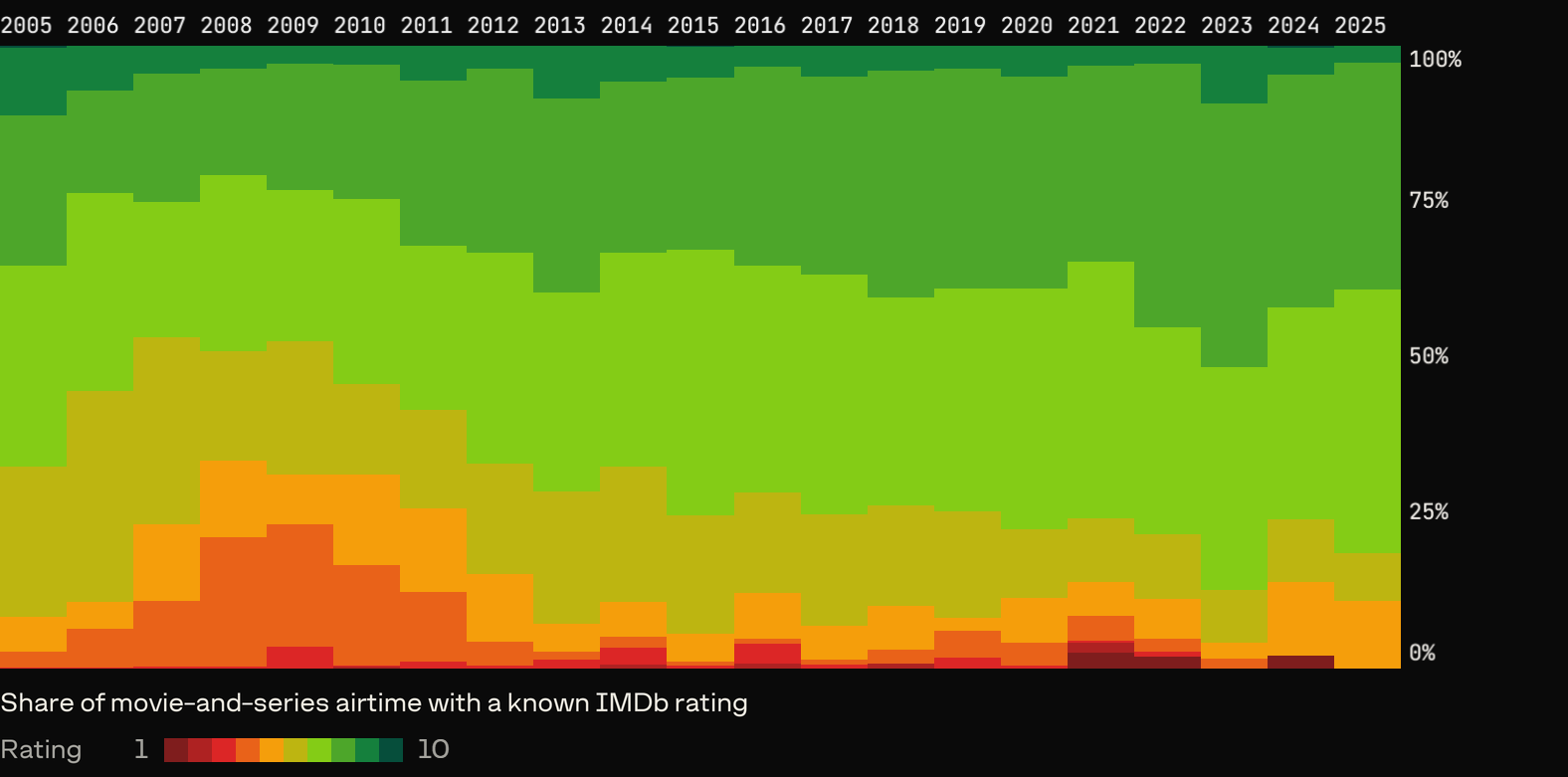
The average IMDb rating for movies and series barely changed: 6.6 in both 2005 and 2025.
The schedule changed enormously, yet the average score stayed the same. Losing foreign productions didn’t, by itself, make the remaining movies and series noticeably worse, at least by IMDb ratings.
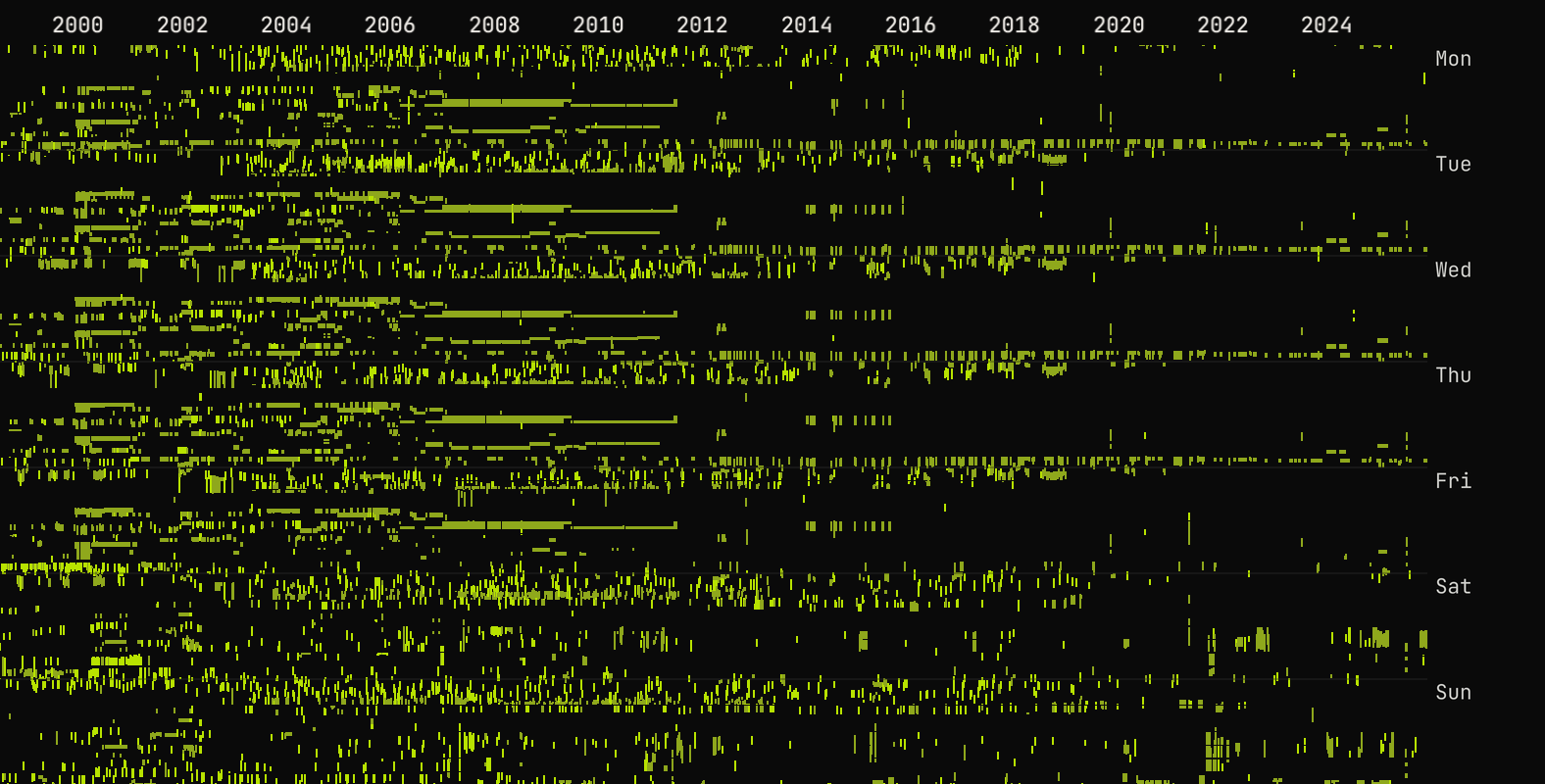
From 1999 to early June 2026, movies and series about cops and investigators occupied roughly 16,500 hours: a quarter of all movie-and-series airtime in that period.
In the 2000s, viewers watched Streets of Broken Lights, National Security Agent, and Deadly Force. Later came Trace and Detectives, followed by The Bloodhound and Cipher in the 2020s. The titles changed, but police work rarely left the schedule.
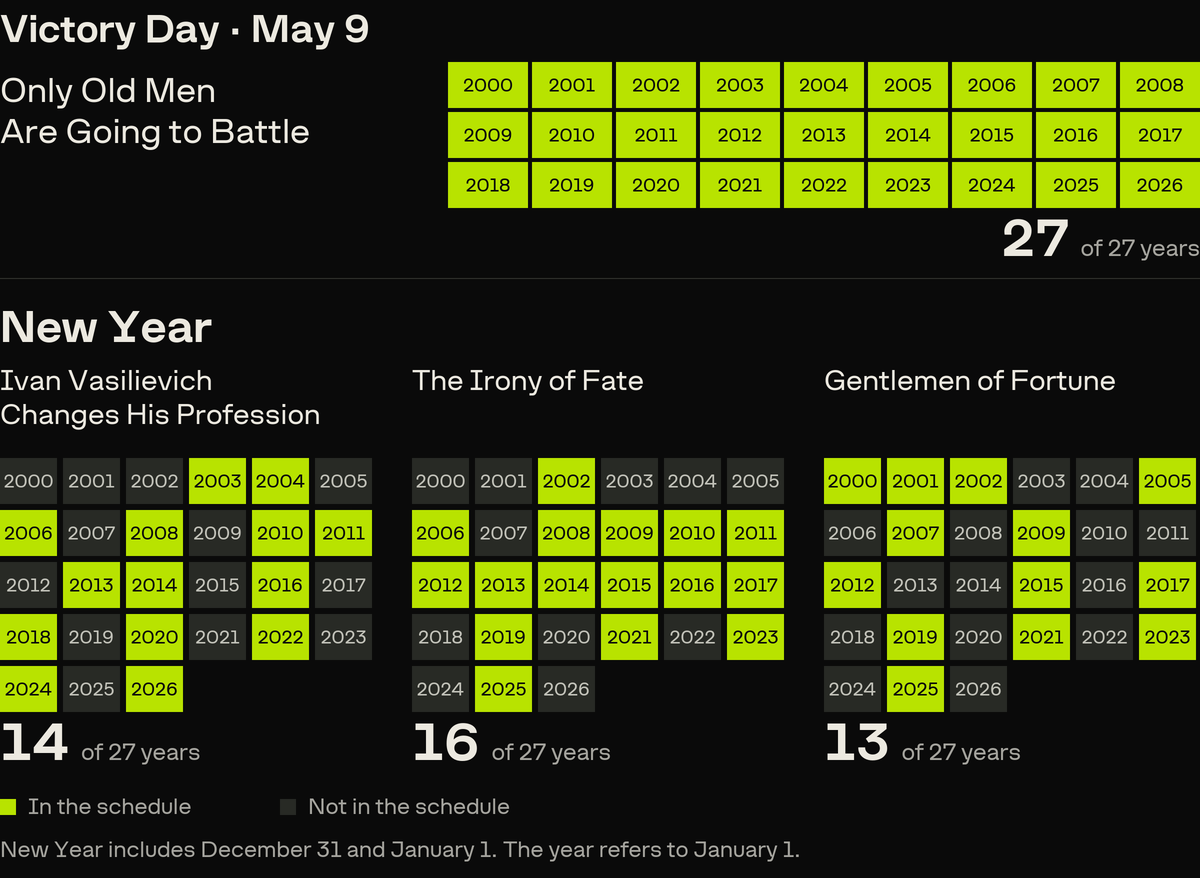
Only Old Men Are Going to Battle, a Soviet film about World War II pilots, appears on Channel One every May 9, Russia’s Victory Day, from 2000 through 2026. All 27 years.
For New Year, the original Irony of Fate appears in 16 of 27 seasons. Ivan Vasilievich Changes His Profession, a time-travel comedy, appears in 14; Gentlemen of Fortune in 13. I counted December 31 and January 1 together: repeating a film across those two days still counts as one season. The Gentlemen here are, of course, the ones without alligators.
Working on the project’s English version made me reconsider why anyone would care about this story. Much of the Russian version relies on shared memories: TV comedian Yevgeny Petrosyan, the sketch show Crooked Mirror, whatever was on while you got ready for school. Readers abroad have none of those memories. Translating every title and explaining who Petrosyan is won’t make them interested.
So for the English version, I choose a different set of scenes and rebuild the story. I want someone who has never watched Russian TV to see how the country changed through it. A familiar format gives them a way in: recognize the similarities, then notice the differences. Comparing Field of Wonders to Wheel of Fortune, for example, tells you what sort of show it is without a detour through its history.
The amount of explanation changes too. A Russian reader sees the title Fashion Verdict and pictures the show. In English, I describe a makeover show that changes people’s clothes and appearance. Now you know what replaced the afternoon soaps. You can follow the schedule without memorizing dozens of unfamiliar names.
Some scenes may even be more interesting to an outsider. For us, Disney next to a priest brings back weekend mornings. For someone else, it’s the surprising sight of familiar cartoons alongside an Orthodox sermon, folk accordion music, and an army show. Those scenes are worth keeping: they work without our memories.
And that’s how a question about a priest became Russian TV Rewind.
I matched the source records to the schedule, normalized them, and grouped them for analysis. Some matches were corrected by hand. These are still schedules, which may differ from actual broadcasts. The archive, title matches, and automated classification may contain errors.
Channel One’s schedule archive: the source of the schedule.
OMDb API (Brian Fritz): movie and series metadata, including IMDb ratings. CC BY-NC 4.0.
IMDb: title and release year matching. Terms of use.
TMDB: additional movie and series metadata. API terms of use. This website uses TMDB and the TMDB APIs but is not endorsed, certified, or otherwise approved by TMDB.
Russian TV Rewind’s own code and visualizations: CC0 1.0. This license excludes third-party data, logos, fonts, and libraries.
Russian TV Rewind is a noncommercial research project. It is free to access, with no advertising or paid services.
LLM instructions: how to reproduce the entire project with a language model.
This format can be adapted for a report, research project or editorial feature built around your data.